
Find the Loan
that Suits you Best

Compare loan options from multiple banks and NBFCs within minutes. Check your credit score and select the best loan options available to you.

4 Steps to the Best Loan

You can compare, pick, and apply for the right loan in just four easy steps

Top Loan Providers in India

Check out personal loan offers from trustworthy lenders that are right for your credit history.

PayRupik​

India’s Largest online mortgage lender

PocketMitra

India’s Largest online mortgage lender

HDFC Bank

India’s Largest online mortgage lender

ICICI Bank

India’s Largest online mortgage lender

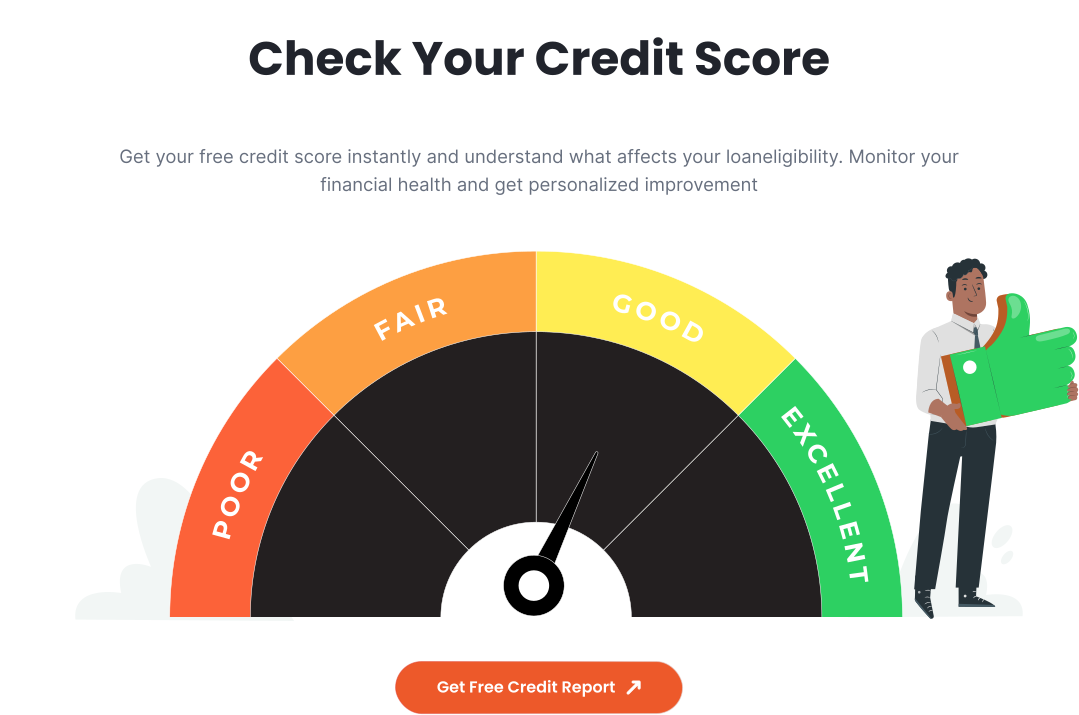
Check your credit score

Get your free credit score right away and find the top loan providers who are ready to offer your loan based on the score.
EMI Calculator
EMI Calculator
Calculate Your Monthly EMI Instantly and Plan Smarter.
Loan Details
Loan Amount
5000000
₹1 Lakh
₹1 Crore
Interest Rate (% per annum)
10.5
6%
25%
Loan Tenure (Months)
60
1 Month
60 Months
Monthly EMI
₹10,747
Total Amount
₹6,44,817
Total Interest
₹1,44,817
Payment Breakdown
Principal Amount
₹5,00,000
Interest Amount
₹1,44,817
Apply Now

Why Choose RupiTap?
for AI-Driven Finance Solutions.

Our Partner's

Frequently Asked Questions

Get Answers to Your Most Common Questions

We've compiled a list of frequently asked questions to provide you with quick and helpful answers.

The process of taking a loan typically involves submitting an application, then attaching all the required docs, along with completion of lender verification. Post which, one shall receive approval for the loan, followed by the loan amount being disbursed.

In order to apply for a loan, one needs to select a loan option that closely fits their requirements. Followed by that, they need to fill-in the loan application form, attach the necessary documents, and then await verification and approval notice from the lender.

"The loan process generally includes 4 stages: 1. Eligibility assessment 2. Filling loan application & documentation 3. Credit evaluation & verification 4. Loan application approval & disbursal"

A CIBIL Score, commonly known as the credit score, is a numerical indicator of an individual's credit history. It usually ranges between 300-900, and is used by the lenders (both private and public) to assess loan eligibility and terms.

The timeline for getting a loan approved varies based on the type of loan and documentation involved. However, most applications are reviewed and processed for further action within a few working days. It's important to connect with the lender for a detailed report of the process.

Loan eligibility can be calculated by evaluating certain factors like, income, existing expenses, credit score, employment stability, and the repayment capacity, as preferred by the lender.

Individuals with a stable and secured source of income, healthy credit history, and ability to repay the loan as per the lender's guidelines are generally considered as clients eligible for a loan.

Applicants with insufficient, or scarce sources of income, poor credit history, unstable employment history, or failure to meet the lender's requirements may not qualify to be candidates eligible for loan.

One can improve their loan eligibility by maintaining a healthy credit score, ensuring regular and stable income, while also reducing existing debts, and submitting complete documents with 100% accuracy in details.

Loan eligibility refers to the criteria implied by a lender to determine whether or not an applicant qualifies for a loan, and how much can they be offered.

Loan repayment comes with its own set of requirements. For instance, the loan repayment must be made as per the agreed schedule, including timely payment of principal and interest, in accordance with the loan agreement.

Loan repayment term is the agreed duration over which the borrower repays the loan through regular installments.

The legal agreement to repay money, also known as a loan agreement, is a legally binding document that outlines the obligations laid down by the borrower, to repay the borrowed amount under pre-determined terms and conditions.

The procedure of repaying the loans is typically done through scheduled instalments, such as EMIs, paid via features like auto-debit, bank transfer, or other legally approved payment methods.

The key conditions, or the key clauses in any loan usually include the loan amount, interest rate, repayment schedule, tenure, penalties, borrower obligations, and terms for default or early repayment.

An interest fee is the cost charged by the lender for borrowing money, which is calculated as a percentage (%) of the loan amount over a specified period of time (T) .

Zero-interest loans are usually available through limited time-periods, with certain employer benefits, or government-backed schemes, and they may involve specific conditions or fees.

The lowest loan rate varies based on the loan type, lender policies, and the borrower's credit profile, with the secured loans generally offering lower rates.

The loan service fees are charges implied by the lender, in order to cover the administrative, processing, and the account maintenance charges related to the loan.

Loan charges may include interest rate, processing fees, late payment penalties, prepayment charges, and other applicable administrative costs.

The process of taking a loan typically involves submitting an application, then attaching all the required docs, along with completion of lender verification. Post which, one shall receive approval for the loan, followed by the loan amount being disbursed.

In order to apply for a loan, one needs to select a loan option that closely fits their requirements. Followed by that, they need to fill-in the loan application form, attach the necessary documents, and then await verification and approval notice from the lender.

"The loan process generally includes 4 stages: 1. Eligibility assessment 2. Filling loan application & documentation 3. Credit evaluation & verification 4. Loan application approval & disbursal"

A CIBIL Score, commonly known as the credit score, is a numerical indicator of an individual's credit history. It usually ranges between 300-900, and is used by the lenders (both private and public) to assess loan eligibility and terms.

The timeline for getting a loan approved varies based on the type of loan and documentation involved. However, most applications are reviewed and processed for further action within a few working days. It's important to connect with the lender for a detailed report of the process.

If you notice any discrepancies in your credit report, you can raise a dispute with your credit bureau for review and correction. Please use the link below to proceed. CRIF : https://hub.crifhighmark.com/dispute-resolution-system/#/login Experian : https://consumer.experian.in/ECSINDIA-DCE/?isDCEFlow=true